Bible Study Translation with Cultural Context.
tri-bible.ai is a translation platform for ministries — built to make Scripture clear, doctrinally faithful, and reproducible across every language you serve.
"But how can they call on him to save them unless they believe in him? And how can they believe in him if they have never heard about him?" — Romans 10:14 (NLT)
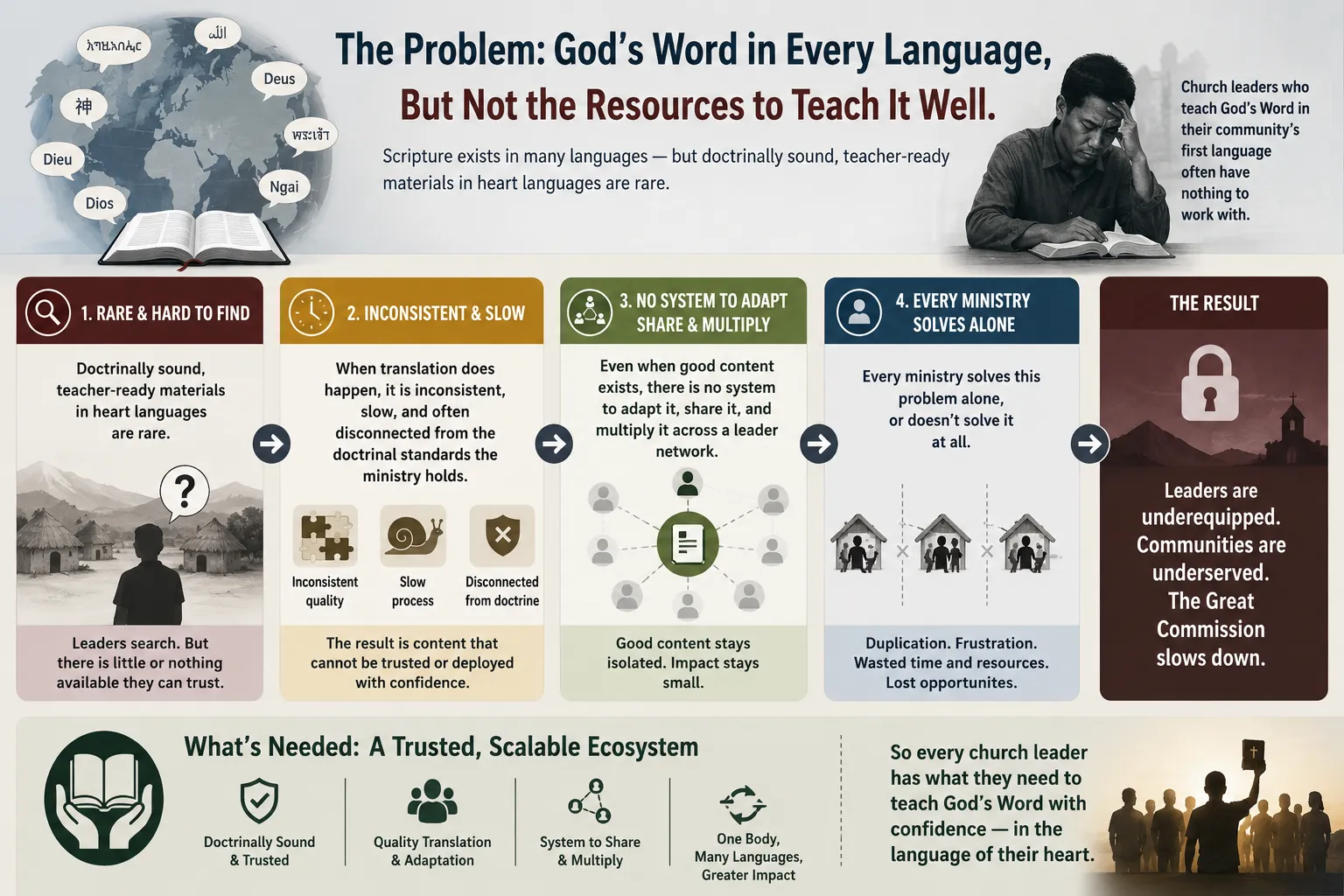
The gap no one is talking about
Scripture exists in many languages — but doctrinally sound, teacher-ready materials in heart languages are rare. Church leaders who teach God's Word in their community's first language often have nothing to work with.
When translation does happen, it is inconsistent, slow, and often disconnected from the doctrinal standards the ministry holds. The result is content that cannot be trusted or deployed with confidence.
Even when good content exists, there is no system to adapt it, share it, and multiply it across a leader network. Every ministry solves this problem alone, or doesn't solve it at all.
"If you speak to people in words they don't understand, how will they know what you are saying?"
— 1 Corinthians 14:9 (NLT)
Introducing tri-bible.ai
Translation Requirements Interface — for ministries that refuse to leave any language behind.
Clear
Every translation is built for comprehension, not just correctness.
Reproducible
Each language has unique requirements that are created once and accessible by anyone.
"To equip the saints for the work of ministry, for building up the body of Christ" Ephesians 4:12 (ESV)
See how it works ↓How tri-bible.ai works
Language package
AI builds a reusable language package for your language and curriculum: glossaries, translation memory, and a doctrine registry. The final step publishes it to the Library.
Internationalize your Bible study
Upload your PDF, Word, or Markdown Bible study and collaborate on culture-specific updates. The goal is to help readers understand and apply the same biblical teaching within their own language and setting.
Approve and translate
Approve the modified study, then translate it. Each translation is scored for cultural clarity and doctrinal readiness.
Publish your study
Export the finished study as a PDF, Word, or Markdown file, ready to share with your group.
The finished language package is published to the Library under an open, non-commercial license, free for anyone to use. Your translated and published studies stay private, shared only with your ministry.
Source — English (NLT)
"For I am not ashamed of this Good News about Christ. It is the power of God at work, saving everyone who believes — the Jew first and also the Gentile."
Romans 1:16
TRI Bible AI output — Hindi
"क्योंकि मैं मसीह के इस सुसमाचार से नहीं लजाता, क्योंकि यह उद्धार के लिए परमेश्वर की सामर्थ्य है — हर उस व्यक्ति के लिए जो विश्वास करता है, पहले यहूदी के लिए, और फिर अन्यजाति के लिए भी।"
रोमियों 1:16
Vocabulary decisions enforced automatically
Good News / Gospel
सुसमाचार is the established Hindi Bible term used in the BSI New Version and matches the doctrinal weight of the Greek euangelion.
salvation
मोक्ष carries the Hindu concept of liberation from the cycle of rebirth. उद्धार is the correct term for Biblical redemption.
power (of God)
शक्ति is the generic Hindi word for energy or force, also used in Hindu goddess worship. सामर्थ्य denotes God's specific sovereign ability.
Built for everyone who teaches God's Word
"Therefore, go and make disciples of all the nations, baptizing them in the name of the Father and the Son and the Holy Spirit. Teach these new disciples to obey all the commands I have given you. And be sure of this: I am with you always, even to the end of the age." — Matthew 28:19-20 (NLT)
Church leaders and ministry networks
- — Bible Study teachers and chapter leaders
- — Seminaries and Bible colleges
- — Multilingual church pastors
- — Lay teachers and small group leaders
"Materials our teachers can use, and a system that scales across every language we serve."
Volunteer contributors
- — Bilingual believers
- — Theology students
- — Translation enthusiasts
"A structured way to serve the Church with the languages God gave me."
Questions
Is this only for large ministries?
No. The platform is designed to serve a single Bible Study teacher with one language community just as well as a denomination with fifty.
How is this different from Google Translate or DeepL?
General translation tools have no awareness of theological terminology, doctrinal standards, or the specific glossary of your ministry. tri-bible.ai uses a multi-agent pipeline specifically calibrated for biblical content, with statement-of-faith alignment, reverse-translation QA, and crowd-sourced theological glossary verification built in.
What languages are supported?
Today, 67 languages are supported, with published translation requirements covering 66 books of the Bible. Each language has its own requirements package built from doctrinal and cultural analysis. See the Library for the full, current list. If you don't find what you're looking for, let us serve you.
What happens when a new book of the Bible is added to a language?
Each new book builds on the language's existing foundation instead of starting over. Every language begins with Romans, which establishes the core theological vocabulary. When Galatians, Ephesians, Philippians, and Colossians were added to Tamil, each book reused the 47 renderings already fixed by the Tamil Romans glossary exactly as recorded, then added its own: 150 newly analyzed terms (like freedom in Galatians, where the common Tamil words for spiritual liberation carry Hindu meanings that had to be rejected) and 115 newly assessed doctrines, each rated for translation risk. The result is one growing, self-consistent glossary per language, so a reader moving between books always meets the same vocabulary.
How long does it take to add a book, and what does it cost?
As a baseline from our current pipeline using Claude Fable 5: producing the full translation requirements package for one New Testament letter takes about 40 minutes of AI processing across 12 pipeline steps, using roughly 220,000 tokens (about 4 to 8 US dollars of model usage at standard pricing). Books are processed in parallel, so four letters were added to Tamil in under an hour end to end. Batch processing halves the token cost for bulk additions. Human theologian review of Critical and High risk terms is additional, and remains the required step before anything is published.
Is this a subscription product?
No, tri-bible.ai is free. See our Terms of use for details.
Who verifies the doctrinal accuracy?
Every language and curriculum starts with Phase 1, an AI-assisted analysis that traces key doctrines back to the original Hebrew, Greek, and Aramaic text and assigns each one a risk level (Critical, High, Medium, or Low) based on how easily it can be mistranslated in that language and culture. Critical and High risk doctrines require review by a human theologian; Medium risk requires review by a native speaker. The resulting doctrine risk registry is published in the Library for every language, so you can see exactly how each doctrine was assessed before any translation work begins.
Who founded tri-bible.ai?
Ben Lorence has served with Bible Study Fellowship (BSF) for nearly two decades, rising from Children's Leader to Online Trainer. He has mentored through Teen Challenge and Alpha, led mission trips to Myanmar, and written weekly Scripture reflections since 2014. Explore his journey at benlorence.blogspot.com.
Looking to partner or volunteer? See the partner FAQs or the volunteer FAQs.